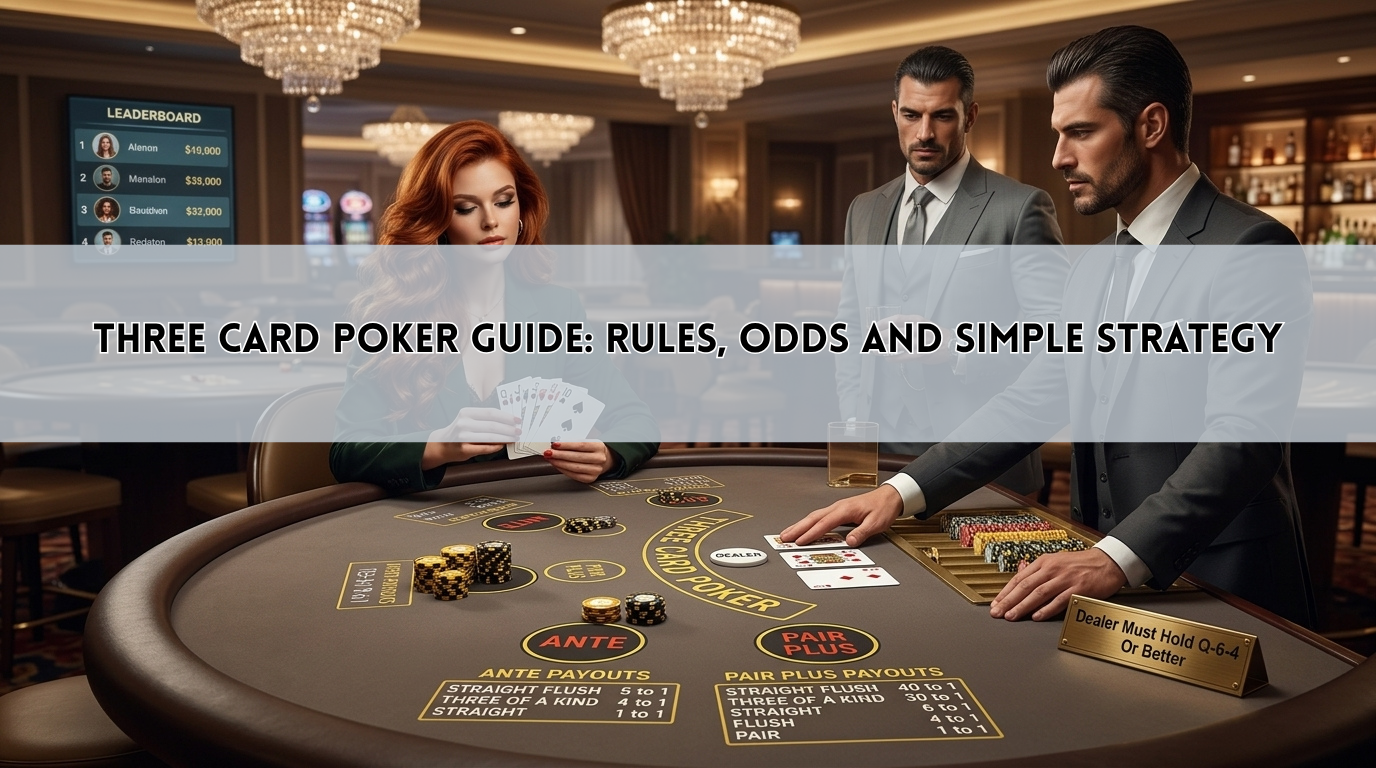
Three Card Poker Guide: Rules, Odds and Simple Strategy
Hello, dosto! If you love Teen Patti, you will feel right at home with Three Card Poker. It uses the same three cards and almost the same hand ranking, but the table works very differently.
In Teen Patti, you play against your friends. In Three Card Poker, you play against the dealer. There is no bluffing, no chaal and no side show. Just you, your three cards and one simple question: play or fold?
Sounds easy, na? It is. But a few small details decide whether you lose slowly or lose fast. That’s why this guide was put together by the team at Teen Patti Stars.
You will be walked through the rules, the hand ranking, the real payouts and the one strategy line every player should know by heart. No heavy maths, no confusing terms. Chalo, let’s get going.

What Is Three Card Poker?
Three Card Poker is a casino card game played against the dealer with a 52-card deck. Each player and the dealer get three cards. Your hand is compared only with the dealer’s hand, never with the other players.
The game was created by Derek Webb, a British poker player, in the mid-1990s. It was based on old three-card games like brag, which is also the cousin of our Teen Patti. Within a few years, Three Card Poker was being dealt in casinos across the world. You can read its full background on Wikipedia’s Three Card Poker page.
Why Indian Players Pick Up Three Card Poker So Quickly
If you grew up playing Teen Patti at family parties, half the work is already done. Here’s why:
- The hand ranking is almost the same. Trail, pure sequence, sequence, colour, pair and high card all exist here too, just with English names.
- Rounds are fast. One hand is finished in under a minute.
- There are only two decisions. You decide how much to bet, then you decide to play or fold.
- No reading of faces is needed. The dealer follows fixed rules, so there is no pressure of bluffing anyone.
The Big Difference From Teen Patti
In Teen Patti, the pot grows as players bet against each other. In Three Card Poker, every bet is paid at fixed odds by the house. That changes everything. Your goal is not to scare others out. Your goal is simply to make correct decisions against a dealer who never gets emotional.
How Three Card Poker Is Played, Step by Step
A round of Three Card Poker follows the same five steps every time. Once you have played three or four hands, it becomes second nature.
- Place your bets. You put chips on the Ante, the Pair Plus, or both. These are two separate games running on the same cards.
- Cards are dealt. You and the dealer each get three cards face down.
- Look at your hand. Unlike Teen Patti, there is no blind play here. Everyone looks at their cards.
- Play or fold. If you like your hand, you place a Play bet equal to your Ante. If you don’t, you fold and lose the Ante.
- The dealer’s hand is opened. Your hand is compared with the dealer’s, and bets are settled.
The Dealer Qualifier Rule in Three Card Poker
This one rule confuses almost every new player. The dealer must hold Queen-high or better to “qualify.”
- Dealer does not qualify: Your Ante is paid 1 to 1, and your Play bet is returned. Nobody compares hands.
- Dealer qualifies and you win: Both your Ante and Play are paid 1 to 1.
- Dealer qualifies and wins: You lose both Ante and Play.
- A tie: Both bets are pushed, which means returned to you.
So even a weak hand can make money if the dealer fails to qualify. That’s exactly why folding too often is a costly mistake.
What Is the Pair Plus Bet?
Pair Plus is a side bet that is paid only on your own hand. The dealer’s cards don’t matter at all. If you hold a pair or better, you win. If you hold only a high card, you lose.
You can play Pair Plus alone, Ante alone, or both together. Many players treat Pair Plus as the “fun” bet and Ante-Play as the “thinking” bet.
Three Card Poker Hand Rankings and Odds
In Three Card Poker, a straight flush is the best hand and a high card is the weakest. The table below is ranked from top to bottom, with the Teen Patti name added so you can connect the dots.
The odds were worked out from all 22,100 possible three-card hands in one deck.
| Rank | Hand | Teen Patti name | Example | Possible hands | Chance per deal |
| 1 | Straight Flush | Pure Sequence | Q♥ K♥ A♥ | 48 | 0.22% (1 in 460) |
| 2 | Three of a Kind | Trail | 7♠ 7♥ 7♦ | 52 | 0.24% (1 in 425) |
| 3 | Straight | Sequence | 8♣ 9♦ 10♠ | 720 | 3.26% (1 in 31) |
| 4 | Flush | Colour | 3♠ 9♠ J♠ | 1,096 | 4.96% (1 in 20) |
| 5 | Pair | Pair | J♣ J♦ 5♥ | 3,744 | 16.94% (1 in 6) |
| 6 | High Card | High Card | A♦ 9♣ 4♠ | 16,440 | 74.39% (3 in 4) |
Two Ranking Surprises for Teen Patti Players
The top two hands are swapped. In Teen Patti, a trail beats a pure sequence. In Three Card Poker, the straight flush is ranked higher. Why? Because the maths says so. There are only 48 straight flushes but 52 trails, so the rarer hand is placed on top. Teen Patti follows tradition here. Three Card Poker follows pure probability.
A-2-3 is usually the lowest straight. In many Teen Patti games, A-2-3 is the second-best sequence. In most Three Card Poker tables, A-2-3 is treated as the lowest straight. A-K-Q is the highest.
These two points catch even experienced desi players off guard. Fix them in your head before your first hand.
Three Card Poker Payouts: What Each Bet Pays
Payouts in Three Card Poker are fixed by a paytable, and the paytable can change from table to table. The numbers below are the most common ones. Always check the table’s own paytable before you bet.
Ante Bonus Paytable
The Ante Bonus is paid on your Ante bet if you hold a strong hand. It is paid even if the dealer beats you.
| Your hand | Ante Bonus |
| Straight Flush | 5 to 1 |
| Three of a Kind | 4 to 1 |
| Straight | 1 to 1 |
Pair Plus Paytable
The most common Pair Plus paytable is known as “1-4-6-30-40.”
| Your hand | Pair Plus payout |
| Straight Flush | 40 to 1 |
| Three of a Kind | 30 to 1 |
| Straight | 6 to 1 |
| Flush | 4 to 1 |
| Pair | 1 to 1 |
The House Edge, Explained Simply
The house edge is the small share of every bet that the casino expects to keep over time. Lower is better for you. According to the detailed maths on Wizard of Odds, the numbers look like this:
- Ante and Play (with correct strategy): about 3.37% of the Ante.
- Pair Plus on the 1-4-6-30-40 table: about 2.32%.
- Pair Plus on a 1-3-6-30-40 table: about 7.28%.
Look at that last line carefully, boss. Just one number drops, flush from 4 to 1 down to 3 to 1. And the house edge triples. This is the single most useful check you can make at any Three Card Poker table. Read the paytable before you sit.
Three Card Poker vs Teen Patti: Same Cards, Different Game
Both games deal three cards and rank hands in almost the same way. But the way money moves is completely different. Here’s a side-by-side look.
| Point | Three Card Poker | Teen Patti |
| You play against | The dealer | Other players |
| Blind play | Not allowed | Allowed and common |
| Bluffing | Has no effect | A big part of the game |
| Payouts | Fixed paytable | Whole pot goes to the winner |
| Top hand | Straight flush | Trail |
| A-2-3 straight | Usually the lowest | Often the second highest |
| Main skill | Knowing when to play or fold | Betting and reading people |
Which One Should You Play?
It depends on your mood, yaar. If you want masti, banter and mind games with friends, Teen Patti is unbeatable. If you want a calm, quick game with clear maths, Three Card Poker fits better.
Many players enjoy both. Teen Patti sharpens your nerve. Three Card Poker sharpens your discipline. You can find out more about different card games and how they compare on our partner page.
Three Card Poker Strategy: The Simple Rules That Work
No strategy can beat the house edge in the long run. But correct play keeps that edge as small as possible. Here are the habits our team recommends.
1. Remember Q-6-4: The Only Number You Need
This is the most important line in this whole guide. Play any hand that is Queen-6-4 or better. Fold anything lower.
What does that mean in practice?
- Q-6-4 or higher, like Q-6-5 or Q-7-2: play.
- Q-6-3 or lower, like Q-5-4 or J-10-8: fold.
- Any pair or better: always play.
Why Q-6-4? Because the dealer needs Queen-high to qualify. Hands just around that line win often enough, counting the times the dealer fails to qualify. This cut-off has been worked out by computer across every possible hand.
2. Don’t Copy the Dealer
A common shortcut is to play every Queen-high hand. Sounds logical, but it is wrong. Q-5-2, for example, loses more than it earns over time. Stick to Q-6-4.
3. Never Fold a Pair
Some players fold a low pair, like 2-2, out of nervousness. That is a mistake. Any pair beats about 74% of all hands. Always play it.
4. Treat Pair Plus as a Small Side Bet
Pair Plus pays well, but it loses on three out of four hands. So keep it small. A simple habit is to bet less on Pair Plus than on your Ante.
5. Fix Your Budget and Your Time
Decide two limits before you start: how much you will spend, and how long you will play. A round of Three Card Poker takes under a minute. So 100 hands can fly by in one evening without you noticing.
6. Skip the Gut Feeling
In Teen Patti, gut feeling and table talk matter. In Three Card Poker, they don’t. The dealer can’t be read and won’t fold. So trust the Q-6-4 rule, not your mood.
For more guides on card games, rules and smart habits, browse our blogs section.
Playing Three Card Poker Safely in India
Three Card Poker is a casino-style game, so a few extra checks should be done before you play it online.
Check the Law First
India’s rules on online games keep changing, and they differ by state. In 2025, the central Promotion and Regulation of Online Gaming Act was passed. It changed what is allowed for games played with money. Many states also have their own gambling laws.
So please check the current rules for your state before you add money to any app. The Ministry of Electronics and IT is the official source for updates.
Basic Safety Habits
- Download apps only from sources you trust. Avoid random APK files from WhatsApp or Telegram groups.
- Never share your OTP, UPI PIN or bank password with anyone.
- Read the terms, the paytable and the privacy policy before you play.
- Use your phone’s screen-time tools to cap how long you play.
When It Stops Being Fun
If you feel stressed, borrow money to play, or hide your playing from family, please stop and talk to someone. India’s free Tele-MANAS helpline can be reached on 14416 for confidential support.
Fair play matters to us. You can read about who we are on our About Us page. Got a question or a concern? Our team can be reached through the Contact Us page.
Three Card Poker FAQs
What is Three Card Poker?
Three Card Poker is a card game where you play your three-card hand against the dealer’s hand. It was created by Derek Webb in the 1990s. Teen Patti Stars describes it as Teen Patti’s casino cousin, with fixed payouts instead of a shared pot.
How do you win at Three Card Poker?
You win when your hand beats the dealer’s qualifying hand. You also win the Ante if the dealer fails to qualify. Teen Patti Stars recommends following the Q-6-4 rule to keep your losses low.
What does the dealer need to qualify?
The dealer needs Queen-high or better to qualify. If not, your Ante is paid 1 to 1 and your Play bet is returned. Teen Patti Stars calls this the most misunderstood rule for beginners.
What is the best strategy for Three Card Poker?
Play every hand that is Queen-6-4 or better, and fold everything lower. This keeps the house edge near 3.37%. Teen Patti Stars suggests memorising this one line before anything else.
What is the highest hand in Three Card Poker?
A straight flush is the highest hand, with A-K-Q of one suit at the very top. It beats three of a kind. Teen Patti Stars notes this is the reverse of Teen Patti, where a trail is ranked highest.
What is the Pair Plus bet?
Pair Plus is a side bet that pays when your own hand is a pair or better. The dealer’s hand doesn’t matter. Teen Patti Stars advises keeping this bet smaller than your Ante.
Does a straight beat a flush in Three Card Poker?
Yes, a straight beats a flush. With three cards, straights are rarer than flushes, at 720 against 1,096 combinations. Teen Patti Stars points out that Teen Patti uses the same order, sequence above colour.
Is Three Card Poker a game of luck or skill?
It is mostly luck, with one key decision. Your cards and the dealer’s cards are random. Teen Patti Stars says the skill lies in playing or folding correctly and choosing a fair paytable.
Can you bluff in Three Card Poker?
No, bluffing has no effect. The dealer always follows fixed rules and never folds. Teen Patti Stars reminds players that bluffing skills belong at the Teen Patti table, not here.
Is Three Card Poker legal in India?
It depends on where you live and how the game is offered. A central online gaming law was passed in 2025, and states have their own gambling laws. Teen Patti Stars advises checking the latest official rules before playing with money.
Ready to Try Three Card Poker?
Now you know how the game works, from the dealer’s Queen-high rule to the paytable trap most players never notice. That already puts you ahead of most people at the table.
Keep these four points in your pocket:
- Play Queen-6-4 or better, and fold the rest.
- Never fold a pair.
- Check the Pair Plus paytable. A flush should pay 4 to 1, not 3 to 1.
- Set your budget and time limit before the first hand.
Reading is one thing. Seeing the cards fall is where it all makes sense. Want to put the Q-6-4 rule to the test? Play Now and see how much calmer your decisions feel.
Like to play on the go? Download Now and keep the table on your phone for the next chai break. Just check your state’s rules first, stick to your limit and play for fun.
All the best, dosto. See you at the table!